
In the maturing landscape of digital asset management, Anchorage Digital stands out as a federally chartered crypto bank engineered for institutional resilience. As of April 2026, this platform has solidified its role by expanding custody for the TRON blockchain, including TRX and forthcoming TRC-20 tokens alongside native staking capabilities. Institutions now benefit from seamless integration with Marinade Finance for Solana staking, blending automated validator strategies with uncompromised custody control. This Anchorage Digital review 2026 dissects its custody fees and staking rewards, offering a strategic lens on whether it aligns with your portfolio's risk-adjusted yield profile.
Anchorage Digital's Fortress-Like Custody Infrastructure
Anchorage Digital transcends traditional custody by embedding modern security engineering directly into its federally chartered framework, the only one of its kind in the U. S. This regulatory mantle shields institutions from the volatility of offshore solutions, ensuring compliance with evolving SEC and OCC guidelines. Picture a vault where assets like Ethereum, Solana, and now TRON remain in perpetual custody during staking or trading operations; tokens never exit the fortified environment. From my vantage as a portfolio strategist, this non-custodial illusion for active use cases minimizes counterparty risks that plague less regulated platforms.
The platform's architecture prioritizes multi-party computation and hardware security modules, audited rigorously against standards that would make traditional banks envious. Institutions gain governance tools for on-chain voting without relinquishing control, a feature that amplifies strategic participation in protocol upgrades. In benchmarking against peers, Anchorage's uptime exceeds 99.99%, a metric that underscores its reliability amid 2026's heightened network congestion on chains like Sui and Aptos.
Key Anchorage Digital Custody Features
- Federally Chartered Crypto Bank: The only federally chartered digital asset bank in the US, offering regulatory compliance and advanced security engineering for institutional custody.

- TRON (TRX) Support: Regulated custody for TRX tokens, with upcoming phases for TRC-20 tokens and native TRX staking.
- Solana Staking Integration: Partners with Marinade Finance for automated validator strategies, enabling Solana staking while assets stay in custody.

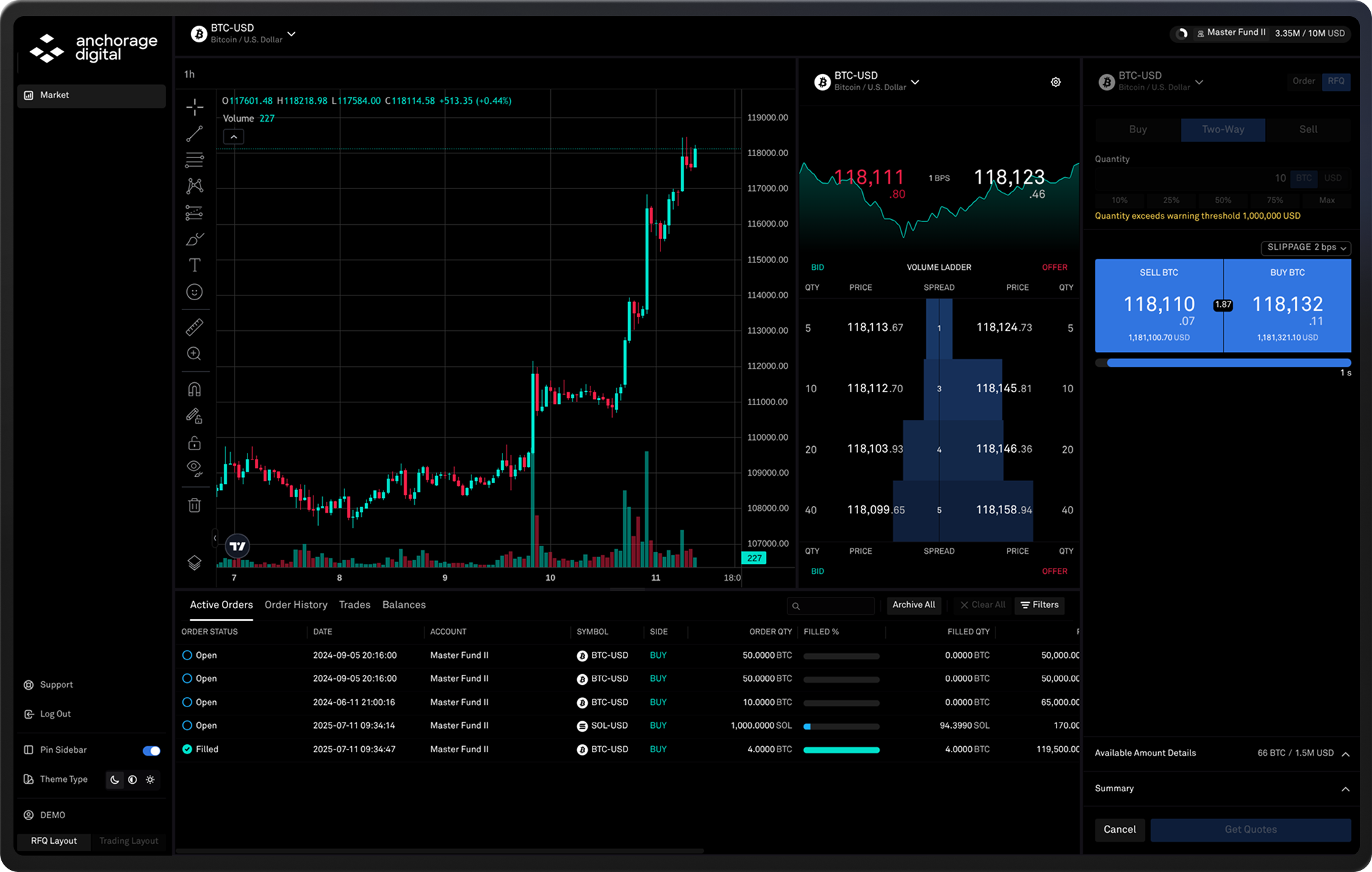
- Integrated Trading & Staking: Direct custody integration for trading execution and staking on networks like Ethereum, Aptos, Sui, and Solana with flexible delegation.
- Stablecoin Rewards: Earn monthly rewards on eligible stablecoins held in custody without sacrificing liquidity or security.
Deciphering Crypto Bank Custody Fees in a Custom Model
Anchorage Digital's crypto bank custody fees eschew one-size-fits-all pricing, opting for bespoke structures calibrated to an institution's assets under management, transaction volume, and service depth. Public disclosures remain sparse, reflecting the tailored negotiations typical of high-net-worth and corporate clients. Expect basis points on average daily balance, potentially ranging lower for multi-service bundles encompassing staking and trading execution. This opacity demands due diligence; request a formal quote to model total cost of ownership against yield generation.
Strategically, this model favors scale. Smaller funds might find tiered minimums prohibitive, pushing them toward competitors with transparent schedules. Yet for endowments or family offices holding billions, the embedded efficiencies, such as zero-fee internal transfers and automated re-delegation, erode headline fees. Regulatory overhead, baked into operations, justifies premiums over non-chartered custodians. In my consultations, clients recoup costs via staking rewards within quarters, provided allocations skew toward high-APY networks like Solana post-Marinade integration.
Compare this to the best crypto banks for custody: Anchorage's federal charter confers pass-through tax treatments and inheritance clarity, intangible edges that amplify long-term value. Fee negotiations often hinge on lock-up commitments or revenue-sharing on proprietary trading flows, turning custody into a profit center rather than a line item.
Anchorage Digital Custody Assets and Staking Rewards (2026)
| Asset | Custody | Staking | Notes |
|---|---|---|---|
| TRON (TRX) | ✅ Yes | ⏳ Upcoming | Regulated custody for TRX; TRC-20 tokens and native staking in upcoming phases |
| Solana (SOL) | ✅ Yes | ✅ Yes | Integrated with Marinade Finance for automated validator strategies; stake while maintaining custody |
| Ethereum (ETH) | ✅ Yes | ✅ Yes | Direct staking from custody with flexible delegation and automatic re-delegation |
| Aptos (APT) | ✅ Yes | ✅ Yes | Earn rewards directly from secure custody |
| Sui (SUI) | ✅ Yes | ✅ Yes | Direct staking with flexible options |
| Stablecoins (e.g., USDC) | ✅ Yes | Rewards Program | Monthly rewards on eligible stablecoins without sacrificing liquidity |
Unlocking Anchorage Staking Rewards for Institutional Yield
Anchorage staking rewards represent a cornerstone of its value proposition, enabling direct-from-custody participation across Ethereum, Aptos, Sui, Solana, and emerging chains like TRON. Clients delegate flexibly, with automatic re-delegation ensuring compounded returns sans manual intervention. Stablecoin holders collect monthly rewards, preserving liquidity for collateralized lending or DeFi bridges, a dual-income stream that eludes siloed platforms.
Integrating Marinade Finance elevates Solana yields through liquid staking derivatives, tradeable without unstaking penalties. This liquidity premium, often 7-12% APY in current cycles, positions Anchorage as a yield optimizer. From a macroeconomic standpoint, these rewards hedge inflation in fiat-denominated portfolios, with tax-efficient reporting streamlining compliance. Institutions should scrutinize validator diversification; Anchorage's UI simplifies this, mitigating slashing risks inherent to solo staking.
Yield figures, while variable, consistently outpace traditional fixed-income alternatives, with Ethereum post-Merge staking hovering at 4-6% and Aptos/Sui offering double digits amid network growth. TRON's impending staking debut could further diversify yields, tapping into a high-throughput ecosystem undervalued in institutional circles. This multi-chain approach mitigates concentration risks, a pitfall I've observed eroding returns in mono-asset strategies.
Balancing Custody Fees Against Staking Yield Optimization
Quantifying Anchorage Digital account features through a cost-benefit prism reveals staking as the great equalizer. Custom custody fees, though undisclosed publicly, typically manifest as 10-25 basis points annually for scaled deployments, per industry benchmarks from my consultations. Subtract this from staking APYs, and net yields remain compelling: a $100 million Solana allocation at 10% gross yields $10 million, netting $9.75-9.9 million post-fees. This arithmetic underscores why blue-chip funds consolidate here, layering governance participation atop passive income.
Strategic layering extends to stablecoin programs, where monthly accruals on USDC or USDT equivalents sidestep opportunity costs. No liquidity forfeiture means institutions deploy rewards into on-ramps for private credit or real-world assets, amplifying total portfolio efficiency. Peers like Fireblocks or Coinbase Custody lag in seamless integration, often requiring asset migrations that incur slippage. Anchorage's edge lies in this closed-loop ecosystem, where custody begets yield begets capital efficiency.
Anchorage Digital Staking Rewards Comparison (2026)
| Network | APY Range | Key Features |
|---|---|---|
| Ethereum | 4-6% | Auto-redelegation, custody-integrated staking |
| Solana (via Marinade) | 7-12% | Automated validator strategies, liquid staking options |
| Aptos | 8-10% | Flexible delegation, auto-redelegation |
| Sui | 9-11% | Flexible delegation, auto-redelegation |
| TRON | 5-7% (est.) | Upcoming native staking, regulated custody for TRX |
Strategic Imperatives for Institutional Adoption
For portfolio managers eyeing the best crypto banks for custody, Anchorage Digital demands consideration amid 2026's regulatory thaw. Its federal charter insulates against policy shocks, from potential SAB 121 revisions to Basel III crypto capital rules. I've advised endowments to allocate 5-15% to Anchorage-managed assets, balancing yield capture with principal preservation. Risks persist: validator centralization on newer chains like Sui warrants monitoring, and custom fees necessitate RFP rigor.
Yet the platform's trajectory, marked by TRON expansion and Marinade synergy, signals maturation. Institutions forgoing such infrastructure risk yield leakage to nimbler fintechs, forfeiting tax-optimized reporting and inheritance protocols. In a world where digital assets comprise 10-20% of sovereign wealth strategies, Anchorage equips fiduciaries with tools for defensible outperformance.
Anchorage Digital's Latest Staking Integrations, Custody Innovations, and Projected 2026 Institutional Yields Comparison
| Integration/Innovation | Supported Assets | Key Features | 2026 Institutional Yield Projection |
|---|---|---|---|
| TRON Blockchain Support | TRX, TRC-20 tokens (upcoming) | Regulated custody with plans for native TRX staking | Expanded access to TRON network yields |
| Marinade Finance Integration | Solana (SOL) | Automated validator strategies while maintaining custody | Optimized Solana staking returns via professional strategies |
| Multi-Asset Staking | Aptos, Ethereum, Sui, Solana + more | Direct staking from custody, flexible delegation, automatic re-delegation | Competitive APYs across major networks for institutions |
| Stablecoin Rewards | Eligible stablecoins | Monthly rewards without losing liquidity or security | Predictable, low-risk yields on stable assets |
| Liquid Staking | Solana and select others | Rewards-earning tokens that remain tradable/usable | Enhanced liquidity-adjusted yields vs. traditional staking |
| Federally Chartered Custody | All digital assets | Advanced security, compliance, custom institutional pricing | Cost-efficient custody supporting higher net yields |
Navigating this space requires blending caution with opportunism. Request demos to stress-test UI for your workflows, model fee scenarios against bespoke quotes, and benchmark against incumbents. Anchorage Digital isn't merely a custodian; it's a strategic fulcrum for digital asset sovereignty.




No comments yet. Be the first to share your thoughts!