
In early 2026, the landscape of American banking has undergone a profound transformation, propelled by decisive regulatory endorsements from the Office of the Comptroller of the Currency (OCC) and affirmations from Federal Reserve Chairman Jerome Powell. These developments have empowered national banks to seamlessly integrate cryptocurrency custody, trading, and related services into their core offerings. No longer confined by prior uncertainties, institutions are now positioning themselves at the forefront of digital asset management, responding to surging institutional demand and a maturing regulatory framework. This 2026 guide dissects the top US banks offering crypto services, highlighting strategic implications for investors and businesses navigating this evolving terrain.

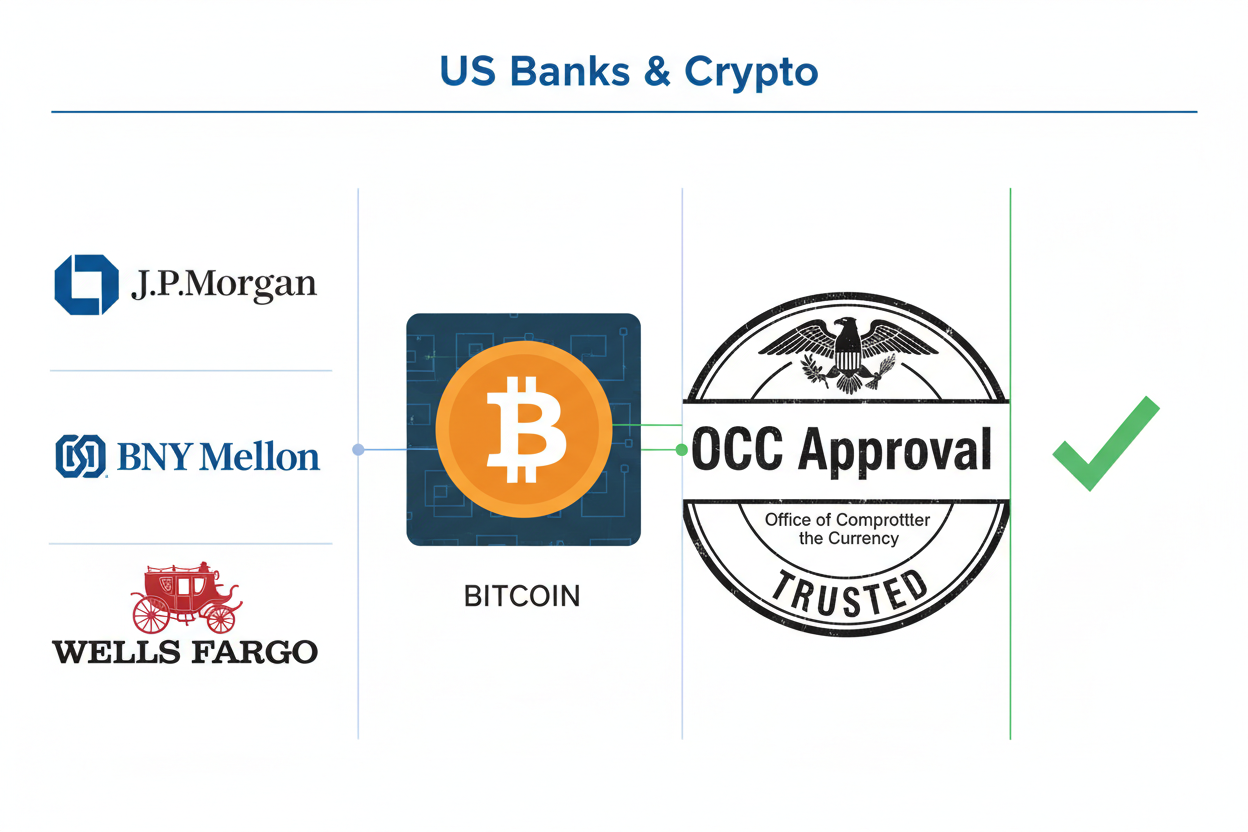
The catalyst for this shift traces back to March 2025, when the OCC issued Interpretive Letter 1183. This pivotal guidance explicitly authorized national banks and federal savings associations to engage in cryptocurrency custody, hold stablecoin reserves, and participate in blockchain networks without seeking prior approval. Acting Comptroller Rodney E. Hood underscored the economic imperative, declaring, ‘Digital assets should and need to be a part of the American economy. ‘ Complementing this, Powell’s public confirmations on crypto banking viability have instilled confidence, signaling a federal embrace of digital assets under stringent risk controls.
OCC Approved Banks Bitcoin Custody Pioneers
Among the frontrunners, U. S. Bank stands out for its proactive resumption of Bitcoin custody services in September 2025. Partnering with NYDIG as sub-custodian, it now caters to institutional managers with comprehensive solutions encompassing ETFs and administration. Similarly, BNY Mellon has scaled its digital asset platform, introducing tokenized deposits in January 2026 to streamline collateral and margin trading for Bitcoin and Ether holders. These moves exemplify how legacy custodians are leveraging established infrastructures for crypto innovation.
JPMorgan Chase has forged a landmark collaboration with Coinbase, enabling Chase customers to fund accounts via credit cards and redeem Ultimate Rewards points for crypto. This user-centric approach democratizes access while mitigating direct exposure risks. State Street, through its Taurus SA partnership, is gearing up for full custody rollout in 2026, focusing on tokenization to enhance asset efficiency amid regulatory evolution.

Powell Crypto Banking Confirmation Fuels Broader Adoption
Federal Reserve Chairman Powell’s endorsements have further accelerated momentum, validating crypto as a legitimate banking adjunct. This clarity has spurred banks like Northern Trust and Citibank to expand offerings. Northern Trust, renowned for asset servicing, now provides tailored crypto custody for high-net-worth clients, emphasizing segregated keys and insurance. Citibank, building on its blockchain pilots, offers institutional trading desks for spot crypto and derivatives, integrating seamlessly with traditional forex operations.
Nubank U. S. , fresh off its OCC conditional approval, targets crypto custody as part of its full-service banking push, bridging Latin American fintech prowess with U. S. compliance standards. Wells Fargo complements this with spot Bitcoin ETF access via advisors, providing regulated exposure without direct custody complexities.
Top 10 US Banks Crypto Services Overview
| Bank | Primary Services (Custody/Trading/ETFs) | Key Partnerships | Launch Timeline |
|---|---|---|---|
| U.S. Bank | Custody, Bitcoin ETFs | NYDIG | September 2025 (resumed) |
| BNY Mellon | Custody (BTC/ETH), Tokenized Deposits | N/A | October 2022 (custody), January 2026 (tokenized) |
| JPMorgan Chase | Trading, Rewards-to-Crypto | Coinbase | July 2025 |
| State Street | Custody, Tokenization | Taurus SA | Planned 2026 (partnership Aug 2024) |
| Northern Trust | Custody | N/A | 2026 (following OCC approvals) |
| Citibank | Custody, Stablecoin Reserves | N/A | 2025-2026 (post-OCC Interpretive Letter 1183) |
| Nubank U.S. | Custody (planned) | N/A | 2026 (OCC conditional approval) |
| Wells Fargo | Bitcoin ETFs | N/A | January 2024 |
| Goldman Sachs | Trading, ETFs | N/A | Ongoing (expanded post-2025) |
| Customers Bank | Custody, Trading | N/A | Post-OCC 2025 approvals |
Delving deeper, Goldman Sachs deploys its sophisticated prime brokerage for crypto trading and lending, catering to hedge funds with over-the-counter execution and yield-generating strategies. Customers Bank distinguishes itself with direct crypto deposits and payments, appealing to fintech integrators seeking banking rails for digital assets. Collectively, these banks underscore a bifurcated strategy: custodians prioritize secure key management and compliance, while trading arms focus on liquidity and execution efficiency. For investors, this convergence promises reduced counterparty risks and enhanced portfolio diversification, though vigilance on jurisdictional variances remains paramount.
Read more on related developments in how U. S. banks hold crypto for blockchain fees and OCC rulings on network participation.
Investors and institutions must adopt a discerning approach when selecting among these OCC-approved banks for bitcoin custody and broader crypto services. Factors such as fee structures, insurance coverage, and integration with existing portfolios weigh heavily. For instance, custodians like Northern Trust emphasize multi-signature protocols and third-party audits, appealing to those prioritizing fortification against quantum computing threats on the horizon. Citibank’s trading desks, meanwhile, offer algorithmic execution that rivals pure-play exchanges, blending forex liquidity with crypto volatility hedging.
Navigating Fees and Incentives in the New Crypto Custody Landscape
Banks holding crypto for fees represent a subtle yet transformative element of this ecosystem. Enabled by OCC guidance, institutions now facilitate blockchain network participation, covering gas fees or stablecoin validations without prohibitive overhead. This positions U. S. banks crypto services 2026 as efficient gateways, where clients benefit from bundled custody and transaction execution. JPMorgan Chase’s Coinbase tie-up exemplifies this, converting rewards points into assets at competitive spreads, while BNY Mellon’s tokenized deposits minimize settlement times to near-instantaneous levels.
Yet, my cautious perspective underscores the need for transparency in these fee models. Goldman Sachs’ prime services command premiums for bespoke lending, yielding 4-6% on collateralized positions, but demand sophisticated risk appetites. Customers Bank’s direct deposit rails, conversely, suit operational treasury functions, enabling seamless fiat-crypto conversions for payroll or remittances.
State Street and Wells Fargo cater to conservative allocations via ETFs, sidestepping outright ownership while capturing upside. Nubank U. S. , with its fintech agility, promises lower entry barriers for retail extensions, potentially disrupting incumbents through superior mobile interfaces.
Regulatory Horizon and Strategic Positioning
Powell crypto banking confirmation has not only greenlit operations but also foreshadowed interoperability standards across Fed-supervised entities. This bodes well for cross-bank asset transfers, reducing silos that once fragmented digital holdings. Northern Trust and Citibank lead in multi-asset reconciliation, integrating crypto with equities and fixed income under unified reporting.
From a macroeconomic lens, these integrations fortify resilience against fiat debasement narratives, with banks like Goldman Sachs pioneering yield strategies amid persistent inflation. However, vigilance on evolving SEC overlays remains essential; derivative exposures could invite scrutiny if not ringfenced. For businesses, Customers Bank’s payment rails streamline supplier settlements in volatile markets, while high-net-worth individuals gravitate toward State Street’s tokenization for illiquid asset fractionalization.
Portfolio strategists should benchmark against peers: U. S. Bank’s ETF-inclusive custody suits index trackers, BNY Mellon’s platform institutional scale-ups. JPMorgan’s accessibility draws mass affluent segments, balancing convenience with Chase’s credit safeguards. This matrix of offerings empowers tailored adoption, aligning digital assets with long-term wealth preservation.
Discover deeper insights on Fed policy fueling crypto services. As regulatory scaffolding solidifies, these top 10 banks – U. S. Bank, BNY Mellon, JPMorgan Chase, State Street, Northern Trust, Citibank, Nubank U. S. , Wells Fargo, Goldman Sachs, and Customers Bank – anchor the bridge between traditional finance and blockchain paradigms, demanding strategic engagement from discerning participants.
About the Author