
In a landmark decision reshaping the landscape of crypto banking regulations 2025, the U. S. Office of the Comptroller of the Currency (OCC) has greenlit national banks to hold cryptocurrency on their balance sheets for paying blockchain network fees. Through Interpretive Letter 1186, the regulator confirms this practice as permissible and incidental to core banking activities like custody services and transaction validation. For crypto users, this ruling signals smoother integration of digital assets into everyday banking, potentially lowering costs and boosting efficiency in handling gas fees.
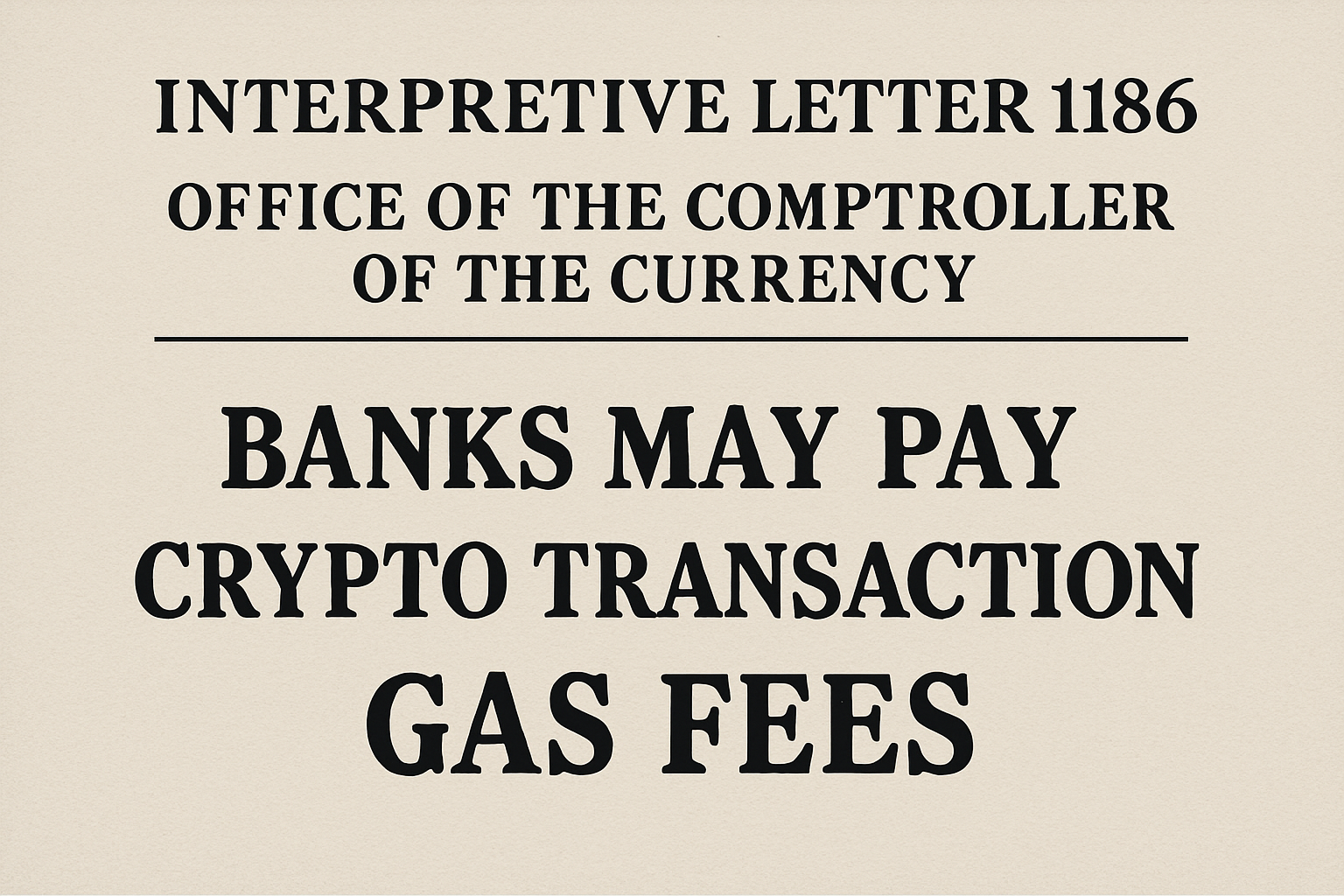
This development arrives at a critical juncture, as banks increasingly eye blockchain-based services amid rising demand for secure crypto custody. Previously, regulatory ambiguity deterred institutions from maintaining crypto reserves solely for operational needs like network fees. Now, with explicit approval, banks can proactively manage these holdings, fostering a more robust infrastructure for digital asset services.
Dissecting Interpretive Letter 1186: Core Permissions and Boundaries
The OCC's letter meticulously outlines the scope of this authority. National banks may acquire and retain crypto-assets necessary to execute transactions on public blockchains, including paying gas fees that validate transfers or smart contracts. This extends to activities such as custody, where banks hold client assets and facilitate movements, or even internal testing of blockchain platforms.
"A national bank may pay network fees, also known as 'gas fees, ' on blockchain networks to facilitate permissible crypto-asset activities. " - Summarized from OCC Interpretive Letter 1186
Crucially, holdings must align with safe-and-sound banking principles. Banks cannot speculate or engage in proprietary trading with these assets; reserves are strictly operational. The guidance draws on prior letters, like those affirming custody rights, building a layered framework for OCC banks crypto holding. Sources from Bloomberg Law and American Banker highlight how this removes a persistent barrier, enabling banks to compete more effectively in blockchain services.
Direct Benefits for Crypto Users in Banking Services
For individuals and businesses navigating US banks hold crypto gas fees, the implications are tangible. Custody services, a cornerstone of crypto banking, now operate with greater seamlessness. Users entrusting assets to banks can expect streamlined transactions without intermediaries absorbing fees unpredictably. This could translate to lower overall costs, as banks internalize gas payments rather than passing them on inflated.
Consider a business processing payroll in stablecoins: previously, fee management added friction. Under this ruling, banks handle it natively, enhancing reliability. Moreover, it paves the way for innovative products, like integrated wallets or DeFi gateways, all under federal oversight. Early adopters among national banks may roll out these features soon, prioritizing networks like Ethereum or Bitcoin where gas dynamics are well-understood.
Regulatory clarity here is a boon. Crypto users have long grappled with fragmented rules across states and agencies. The OCC's stance provides a federal anchor, likely encouraging state-chartered banks to follow suit via reciprocal permissions. As noted in Forbes coverage, this erodes major hurdles to mainstream blockchain entry.
Navigating Risks: How Banks Will Safeguard Holdings
While promising, the ruling mandates rigorous risk management. Banks must address market volatility - crypto prices swing wildly - alongside cybersecurity threats inherent to digital wallets. The OCC emphasizes maintaining reserves in cold storage or equivalent secure setups, with comprehensive controls for access and auditing.
Operational risks loom too: network congestion can spike gas fees unexpectedly, straining liquidity. Institutions will likely model these scenarios, holding buffers calibrated to peak usage. For users, this underscores the value of FDIC-insured banks venturing into crypto; even operational holdings benefit from established prudential standards.
Learn more in our detailed guide on US banks holding crypto for fees.
This framework positions banks as reliable stewards, blending traditional diligence with blockchain realities. Users should monitor announcements from major players like JPMorgan or BNY Mellon, who have signaled interest in expanding crypto operations.
Institutions like these have already dipped toes into crypto custody, and this ruling accelerates their pivot toward full-spectrum services. Expect pilot programs where banks test gas fee payments on high-volume networks, refining processes before scaling to retail clients.
Blockchain Networks in Focus: Ethereum, Bitcoin, and Beyond
The OCC guidance does not specify networks, but practical application points to established chains. Ethereum's gas fees, notorious for variability during congestion, stand to benefit most from bank-managed holdings. Banks can pre-allocate ETH reserves, smoothing out spikes that plague decentralized exchanges. Bitcoin, with its simpler fee model tied to satoshis per byte, offers lower volatility, making it ideal for testing operational custody.
Layer-2 solutions and emerging chains like Solana could follow, as banks validate compatibility with federal standards. This selective integration underscores a methodical rollout: prioritize proven protocols before venturing into uncharted territories. For users, it means discerning which banks support their preferred assets; transparency in disclosures will be key.
Shifting dynamics also ripple through crypto banking regulations 2025. The ruling aligns with SEC and Fed efforts, potentially harmonizing oversight. Yet, it stops short of proprietary trading approvals, maintaining firewalls against speculation. This balance reassures depositors while empowering innovation.
Strategic Moves for Crypto Users: Positioning for Change
As banks operationalize these permissions, users gain leverage. First, evaluate custody providers through a risk-adjusted lens: seek institutions with proven blockchain nodes and audited reserves. Platforms disclosing gas fee policies transparently signal preparedness.
Businesses handling high transaction volumes should benchmark current costs against bank alternatives. A DeFi trader paying $50 in ETH gas during peaks might save via bank facilitation, where fees amortize across volumes. Retail users, meanwhile, anticipate bundled services - think checking accounts with native crypto sends, fees deducted seamlessly.
Tax implications merit attention too. Operational holdings by banks do not trigger user events, but facilitated transactions might. Consult advisors familiar with IRS crypto rules, especially as Form 1099 reporting evolves for digital assets.
Explore our guide to top custody providers for vetted options in this new era.
Comparison of Major US Banks' Crypto Custody Offerings
| Bank | Services | Networks Supported | Fee Structures |
|---|---|---|---|
| JPMorgan | Custody ✅, Gas Fee Payments ✅ | Ethereum, Polygon, Solana | Tiered custody fees (0.1-0.5%); reimburses or covers gas fees for clients |
| BNY Mellon | Custody (expanding) ✅, Gas Fee Payments ✅ | Bitcoin, Ethereum, expanding to others | 0.2-0.4% AUM custody fees; network fees passed through or covered |
| State Street | Exploring Custody, Gas Fee Support (planned) | Ethereum (planned), others TBD | Fee structure TBD; competitive institutional rates expected |
Competition will sharpen. Non-bank custodians like Coinbase Custody face stiffer rivalry from FDIC-backed entities, possibly compressing margins. This pressures the ecosystem toward efficiency, benefiting end-users with competitive pricing and superior security.
Long-Term Horizon: Mainstreaming Digital Assets
Zooming out, Interpretive Letter 1186 fits a trajectory of regulatory thawing. Recall 2020's custody nod and 2021's stablecoin payments; each brick builds toward crypto as infrastructure. By 2026, banks holding operational crypto could normalize, mirroring how they manage forex reserves today.
Risks persist - a crypto winter or hack could test resolve - but prudential rules mitigate. The OCC's insistence on safe-and-sound practices ensures resilience, drawing parallels to post-2008 reforms. Users stand to inherit a hybrid system: blockchain speed wedded to banking stability.
For those banking on digital assets, this evolution demands vigilance. Track quarterly filings for crypto balance disclosures, engage with forward-leaning institutions, and diversify across custodians. The payoff? Frictionless access to blockchain utility within trusted rails.
National banks stepping up on banks blockchain network fees mark not just permission, but momentum. Crypto users equipped with this knowledge navigate the shift astutely, capitalizing on efficiencies while sidestepping pitfalls. As integration deepens, the divide between traditional finance and decentralized networks narrows measurably.





No comments yet. Be the first to share your thoughts!