
Crypto neobanks in 2026 have turned digital asset spending into a seamless reality, with JupGlobal, KAST, and Xplace leading the pack alongside AviciMoney and RedotPay. These platforms bridge traditional banking and blockchain, offering cards that let you spend crypto globally while chasing cashback and low fees. As Solana ecosystem hype peaks, picking the right one hinges on your spend volume, reward preferences, and tolerance for tiered costs. This comparison dives into their fees, card options, and cashback structures to spotlight winners for everyday users and high rollers.



JupGlobal stands out for its aggressive fee minimization, especially appealing to Solana loyalists. Sources highlight a 0% top-up fee, though Visa might tack on 0.4% to 1% for non-USD transactions. Exact card details remain sparse, but it integrates tightly with Solana wallets for direct USDC spends. No robust cashback program is confirmed yet, positioning JupGlobal as a lean option for cost-conscious users who prioritize self-custody over flashy rewards. If you're stacking SOL and want frictionless top-ups, this neobank avoids the premium traps of competitors.
KAST Delivers Consistent 4% Cashback Across Tiers
KAST flips the script with uniform cashback regardless of card level, paying 4% in $MOVE tokens on all tiers, capped at $2,000 monthly spend. The Standard K Card skips annual fees and ships as plastic, ideal for testing waters. Upgrade to Premium X Card for $1,000 yearly and get metal construction, or drop a one-time $5,000 on the Founders Card for VIP concierge perks alongside the same metal build. Season 5 Points add 2% extra for Standard users, and SOL staking multipliers juice returns further. No transaction fees mentioned beyond potential network costs make KAST a high-yield pick if $MOVE volatility suits your risk profile.
KAST Card Tiers Comparison
| Tier | Annual Fee | Card Type | Cashback | Additional Perks |
|---|---|---|---|---|
| Standard K 🥉 | No annual fee | Plastic | 4% in $MOVE tokens (capped at $2,000 monthly spend) | Season 5 Points (2%), SOL staking multipliers |
| Premium X 🥈 | $1,000 annual fee | Metal | 4% in $MOVE tokens (capped at $2,000 monthly spend) | - |
| Founders 🥇 | $5,000 one-time fee | Metal + VIP Concierge | 4% in $MOVE tokens (capped at $2,000 monthly spend) | - |
Xplace Tiers Trade Fees for Escalating Perks
Xplace structures around clubs with a flat 1% transaction fee hitting every purchase, potentially eroding cashback gains. Standard Card is virtual and free, but zero cashback leaves it basic. Silver Club at $200 annual unlocks 0.5% USDC cashback with plastic physical card. Gold jumps to $1,000 for 1% USDC and metal, while Platinum's $5,000 annual fee brings 2% USDC on a mirror metal card. As a financial super app, Xplace emphasizes global crypto spending, but that universal 1% fee demands high volume to justify upgrades over KAST's fee-free model.
Stacking these against AviciMoney and RedotPay rounds out the top five. AviciMoney garners buzz for IBAN and Visa support in Solana neobank rankings, though fee specifics lag. RedotPay follows suit with strong everyday utility, often cited for low barriers in Medium lists. JupGlobal edges on top-up costs, but KAST's $MOVE rewards shine for yield hunters, while Xplace suits USDC purists willing to pay for prestige.
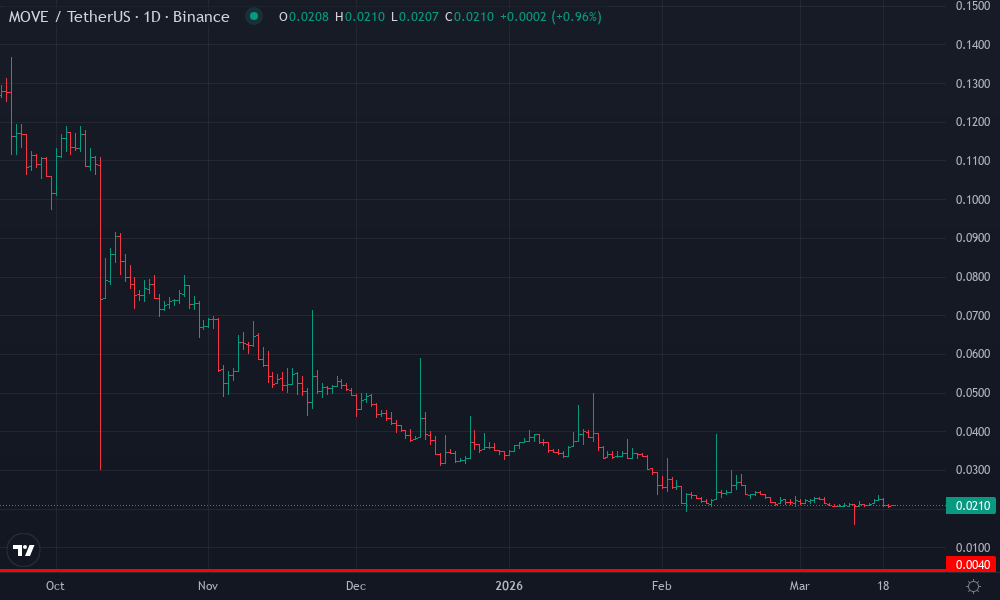
MOVE Technical Analysis Chart
Analysis by Nathaniel Ross | Symbol: BINANCE:MOVEUSDT | Interval: 1D | Drawings: 7
Technical Analysis Summary
As Nathaniel Ross, employ a conservative hybrid approach emphasizing risk-defined structures. Initiate with a primary downtrend line (trend_line) connecting the November 2026 swing high at approximately 0.0098 to the late March 2026 swing high near 0.0028, extending to project continuation. Add horizontal_lines at key support (0.0018) and resistance (0.0028, 0.0040). Rectangle the recent consolidation zone from mid-March to early April between 0.0018-0.0025. Use fib_retracement from the December low to March high for potential retracement levels. Mark volume spikes with callouts during breakdowns. Place arrow_mark_down on MACD bearish divergence. Horizontal lines for entry/exit zones at 0.0022 long entry, 0.0017 stop loss, 0.0032 profit target. Vertical_line for major dump in early December 2026. Text annotations for risk notes: 'Low risk tolerance - scale in only on confirmation.'
Risk Assessment: high
Analysis: Persistent downtrend structure, low volume bounces, crypto sector volatility amplified by altcoin dynamics despite neobank tailwinds
Nathaniel Ross's Recommendation: Sideline or scale short with <1% risk per trade; await bullish structure break for longs. Preserve capital - my mantra.
Key Support & Resistance Levels
📈 Support Levels:
- $0.002 - Multi-touch recent lows, potential accumulation base amid KAST $MOVE rewards strong
- $0.002 - Intermediate support from early April greens moderate
📉 Resistance Levels:
- $0.003 - Recent swing high, initial hurdle moderate
- $0.004 - Prior December bounce high, key overhead strong
Trading Zones (low risk tolerance)
🎯 Entry Zones:
- $0.002 - Dip buy near support if volume confirms hold, aligned to low-risk hybrid setup medium risk
🚪 Exit Zones:
- $0.003 - Measured move target to next resistance 💰 profit target
- $0.002 - Tight stop below key support to limit downside 🛡️ stop loss
Technical Indicators Analysis
📊 Volume Analysis:
Pattern: Declining on ups, spiking on breakdowns indicating distribution
Bearish volume profile supports downtrend continuation
📈 MACD Analysis:
Signal: Bearish crossover with divergence
MACD histogram contracting negatively, no bullish momentum
Applied TradingView Drawing Utilities
This chart analysis utilizes the following professional drawing tools:
Disclaimer: This technical analysis by Nathaniel Ross is for educational purposes only and should not be considered as financial advice. Trading involves risk, and you should always do your own research before making investment decisions. Past performance does not guarantee future results. The analysis reflects the author's personal methodology and risk tolerance (low).
Fee Breakdowns Reveal Hidden Costs
Drilling into fees separates pretenders from performers. JupGlobal's 0% top-up sidesteps common pain points, but undefined ongoing costs warrant caution. KAST imposes no surprises beyond card premiums, letting cashback compound cleanly up to the cap. Xplace's 1% tx fee applies universally, so a $5,000 monthly spend nets just $50 back on Platinum minus $50 fee, breaking even at best. For low spenders under $2,000, KAST's Standard crushes with pure 4% upside. High-volume users might lean Xplace if 2% USDC stability trumps $MOVE swings, but always factor Visa add-ons around 0.4%.
Card materials signal commitment levels: plastic for entry, metal for mid-tier, exotics like mirror for elite. Cashback currencies matter too; $MOVE ties to KAST's ecosystem for potential staking boosts, while Xplace's USDC offers stability. JupGlobal, AviciMoney, and RedotPay fill niches with Solana focus, but lack tier depth compared to these dueling heavyweights.
AviciMoney and RedotPay deserve a closer look as they round out the top five crypto neobanks in 2026 Solana rankings. AviciMoney earns nods for full IBAN integration and Visa cards, making it a hybrid powerhouse for users blending fiat rails with crypto spends. Fee details stay light in sources, but its positioning suggests competitive top-ups without the tiered premiums of Xplace or KAST. Expect straightforward plastic or virtual options geared toward everyday Solana transactions, with potential cashback in ecosystem tokens though unconfirmed rates trail the leaders.
AviciMoney and RedotPay: Solana Specialists with Everyday Edge
RedotPay mirrors this utility focus, frequently listed for accessible Visa/Mastercard issuance and low entry barriers. No annual fees surface in comparisons, positioning it as a JupGlobal alternative for fee-averse spenders. Both platforms prioritize Solana wallet connectivity, sidestepping custodial risks better than legacy options like Revolut's crypto fees. Cashback lags without specifics, but their no-frills approach suits beginners dodging $MOVE volatility or Xplace's tx drag. In a field where Solana neobanks dominate Medium and X chatter, these two provide reliable backups if JupGlobal's sparse rewards or tiered rivals feel mismatched.

Risk management demands scrutinizing these beyond headlines. $MOVE cashback from KAST amplifies with staking, but token drawdowns could wipe smiles from low-volume users hitting the $2,000 cap. Xplace's USDC stability appeals to conservatives, yet that 1% fee compounds on small spends, turning a $100 grocery run into a 0.5% net loss on Silver. JupGlobal's 0% top-up shines for direct USDC wallet drains, minimizing conversion slippage, but absent cashback means opportunity cost versus KAST's 4%. AviciMoney and RedotPay mitigate this with presumed flat structures, ideal for conservative portfolios where principal preservation trumps yield chasing.
Tailored Picks by User Profile
Low spenders under $2,000 monthly? KAST Standard K Card maximizes 4% $MOVE without upfront costs, boosted by Season 5 Points. Pair with SOL staking for compounded gains if you stomach volatility. Moderate users eyeing prestige lean Xplace Gold at $1,000 yearly, netting 1% USDC minus fees on higher volumes. High rollers drop $5,000 on KAST Founders or Xplace Platinum for concierge and mirror bling, though KAST's superior rate wins unless USDC predictability rules your book.
JupGlobal fits purists wanting zero top-up friction, especially Solana maxis linking to self-custody wallets like Solflare. AviciMoney edges for IBAN needs in Europe, while RedotPay handles global merchants sans drama. Always audit Visa surcharges at 0.4% minimum; they level many fields. For yield while holding, KAST's multipliers edge Pistachio Fi benchmarks, but diversify across neobanks to hedge platform risks.
Crypto Neobanks 2026 Comparison: JupGlobal vs KAST vs Xplace vs AviciMoney vs RedotPay
| Neobank | Top-up Fee | TX Fee | Cashback (rate/currency/cap) | Card Tiers (entry fee/material) | Solana Integration |
|---|---|---|---|---|---|
| JupGlobal | 0% 🚀 | Visa 0.4-1% ⚠️ | N/A | N/A | Native (Solana ecosystem) 🚀 |
| KAST | N/A | N/A | 4% $MOVE / $2,000 monthly spend cap 🚀 | Standard K: $0 annual/plastic; Premium X: $1,000 annual/metal; Founders: $5,000 one-time/metal VIP | SOL staking multipliers 🚀 |
| Xplace | N/A | 1% (all tiers) ⚠️ | 0% (std); 0.5% (silver); 1% (gold); 2% (platinum) USDC | Standard: $0/virtual; Silver: $200 annual/plastic; Gold: $1,000 annual/metal; Platinum: $5,000 annual/mirror metal | N/A ⚠️ |
| AviciMoney | N/A | N/A | N/A | N/A | Yes 🚀 (#2 Solana neobank) |
| RedotPay | N/A | N/A | N/A | N/A | Yes (#4 Solana neobank) |
Security layers vary too. KAST and Xplace tout non-custodial vibes, but verify self-custody claims against Solflare's zero-fee benchmark. Limits on spends or withdrawals rarely surface, yet YouTube deep dives like MoneyZG flag availability hurdles in select regions. As a risk specialist, I stress: match neobank to spend patterns, not hype. KAST leads for reward density, Xplace for tiered stability, JupGlobal for minimalism. AviciMoney and RedotPay anchor the pack for Solana faithful seeking unpretentious access. Monitor $MOVE trajectories against USDC floors; mismatching rewards to your risk tolerance invites losses. These platforms evolve fast in 2026's digital banking surge, so pilot with small top-ups before committing tiers.





No comments yet. Be the first to share your thoughts!