
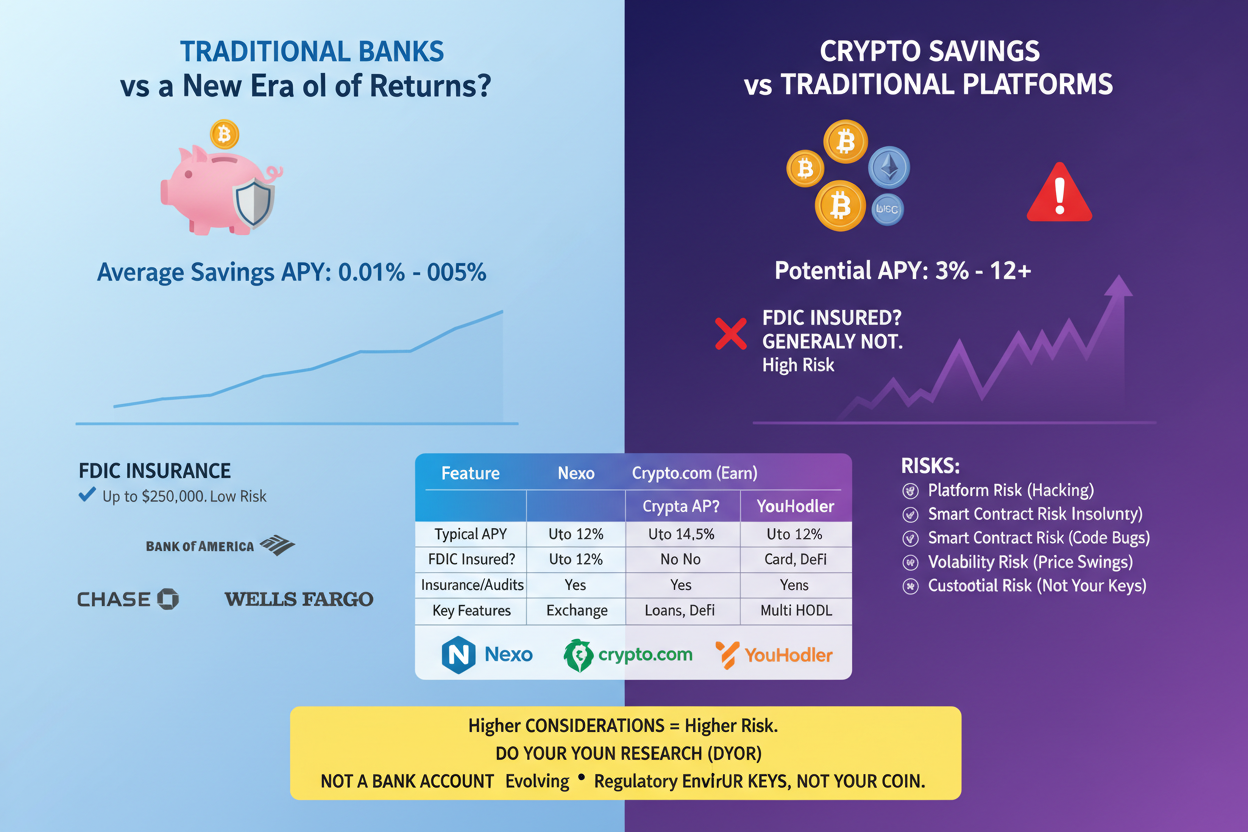
In February 2026, the savings landscape splits sharply between traditional banks offering steady 4-5% APY with full FDIC protection up to $250,000 and crypto platforms pushing 8-16% yields through lending, staking, and DeFi. Traditional options suit risk-averse savers prioritizing capital preservation; crypto banks appeal to those chasing amplified returns amid volatility. This comparison spotlights why high yield crypto savings accounts often outpace crypto banks vs traditional banks interest, but demand rigorous risk assessment.
Current data underscores the gap. Varo Bank delivers 5.00% APY on balances up to certain thresholds, no minimums required. Newtek Bank counters at 4.35% APY, equally accessible. These rates, from sources like Forbes and Investopedia, dwarf the national average of 0.61% APY, yet pale against stablecoin yields hitting 6-18% on fintech platforms. Online-only institutions dominate with liquidity and no-fee structures, but yields hover below inflation in volatile economic climates.
Traditional High-Yield Savings: Security Anchors Returns
Brick-and-mortar banks lag far behind, but digital natives like Marcus by Goldman Sachs maintain competitive edges around 4.21% APY per NerdWallet rankings. FDIC insurance eliminates principal loss fears, a cornerstone for emergency funds or short-term goals. Withdrawals remain instant, fees minimal, and customer service robust. However, rates fluctuate with Federal Reserve policies; expect downward pressure if cuts materialize. For conservative portfolios, these accounts form the bedrock, delivering predictable compounding without sleepless nights over market dips.
Yet, this stability caps upside. Savers parking $100,000 at 5% earn $5,000 annually pre-tax. Solid, but uninspiring against crypto's potential. Traditional banks excel in regulatory compliance and inheritance ease, but innovation stalls here. No exposure to blockchain efficiencies or global yield farming means missed opportunities in a digitized economy.
Crypto Banks Enter the Arena: Top Platforms for Superior Yields
Crypto savings accounts redefine earning potential. Platforms like Nexo, Crypto. com, YouHodler, Ledn, and OKX lead with APYs exceeding 8-16%, fueled by stablecoin lending to institutions and DeFi protocols. Nexo offers tiered rates up to 12% on assets like USDC, with loyalty bonuses boosting returns for long-term holders. Crypto. com pairs 10% and yields on CRO-staked deposits with exchange perks, blending savings and trading.
YouHodler stands out for multi-currency support, delivering 11-15% on stablecoins via leveraged lending, no lockups needed. Ledn focuses on Bitcoin and stablecoin savers, guaranteeing 9-14% through transparent proof-of-reserves audits. OKX rounds the group with flexible 8-16% rates across Earn products, integrating seamlessly with its vast trading ecosystem. These best crypto banks for deposits 2026 leverage idle crypto for institutional borrowers, passing premiums to users.
Higher yields stem from blockchain's borderless capital markets. Stablecoins like USDT sidestep fiat drags, yielding 6-18% versus banks' 0.4-5%. But volatility lurks: platform hacks, smart contract failures, or regulatory crackdowns amplify downside. No FDIC equivalent exists; insurance pools cover partial losses at best.
Cryptocurrency Price Performance: Stablecoins and Platform Tokens (6-Month Comparison)
Key assets related to crypto high-yield savings platforms vs. market benchmarks, highlighting stability and risks as of 2026-02-19
| Asset | Current Price | 6 Months Ago | Price Change |
|---|---|---|---|
| Tether (USDT) | $1.00 | $1.00 | -0.0% |
| USD Coin (USDC) | $0.0200 | $1.00 | -98.0% |
| DAI (DAI) | $0.000988 | $1.00 | -99.9% |
| Bitcoin (BTC) | $66,352.00 | $124,752.53 | -46.8% |
| Ethereum (ETH) | $1,920.95 | $4,687.77 | -59.0% |
| Cronos (CRO) | $0.0777 | $0.1000 | -22.3% |
| Nexo (NEXO) | $0.8503 | $1.20 | -29.1% |
| OKB (OKB) | $77.80 | $100.00 | -22.2% |
Analysis Summary
Over the past six months, Tether (USDT) maintained perfect stability at $1.00, while other stablecoins USDC and DAI depegged dramatically (-98.0% and -99.9%). Major cryptocurrencies BTC and ETH declined sharply (-46.8% and -59.0%), and platform tokens for crypto savings providers (CRO, NEXO, OKB) fell 22-29%, underscoring volatility risks versus traditional bank stability.
Key Insights
- USDT held its $1 peg flawlessly, supporting its use in low-risk crypto savings.
- USDC and DAI experienced catastrophic depegs, emphasizing stablecoin risks.
- BTC and ETH saw the steepest declines amid market corrections.
- Platform tokens like CRO (-22.3%), NEXO (-29.1%), and OKB (-22.2%) were less volatile than majors but still down significantly.
Real-time data from CoinMarketCap (current as of 2026-02-19 vs. 2025-08-23 historical snapshot). Price change = ((current price - 6mo ago price) / 6mo ago price) × 100, formatted exactly as provided.
Data Sources:
- Main Asset: https://coinmarketcap.com/historical/20250823/
- USD Coin: https://coinmarketcap.com/historical/20250823/
- DAI: https://coinmarketcap.com/historical/20250823/
- Bitcoin: https://coinmarketcap.com/historical/20250823/
- Ethereum: https://coinmarketcap.com/historical/20250823/
- Cronos: https://coinmarketcap.com/historical/20250823/
- Nexo: https://coinmarketcap.com/historical/20250823/
- OKB: https://coinmarketcap.com/historical/20250823/
Disclaimer: Cryptocurrency prices are highly volatile and subject to market fluctuations. The data presented is for informational purposes only and should not be considered as investment advice. Always do your own research before making investment decisions.
Yield Mechanics: How Crypto Outpaces Tradition
Traditional interest accrues via fractional reserve lending, constrained by capital requirements. Crypto platforms deploy funds into overcollateralized loans or liquidity pools, capturing risk premia banks avoid. For instance, Nexo's model lends user stablecoins to verified borrowers at 10-20% rates, netting users the spread after fees. This efficiency drives crypto banks savings rates supremacy.
Crypto. com's Earn program similarly allocates deposits to high-demand borrowers, often in CeFi environments, sustaining 10% yields even during lulls. YouHodler's dynamic multiplier system adjusts rates based on holdings, pushing boundaries to 15% for aggressive users. Ledn's Bitcoin-backed loans minimize counterparty risk, while OKX taps into perpetual futures funding rates for steady 16% peaks. These mechanisms bypass legacy banking frictions, but success hinges on platform solvency and market depth.
Navigating Risks: Crypto's Hidden Costs
Superior returns demand scrutiny. Crypto platforms lack FDIC shields, exposing funds to hacks like the 2022 Ronin breach or FTX collapse echoes. Nexo boasts $775 million insurance, yet coverage gaps persist for hot wallets. Crypto. com weathered outflows post-2022 but enforces withdrawal limits during stress. YouHodler mandates KYC for high tiers, mitigating fraud but eroding privacy. Ledn's transparent reserves build trust, audited quarterly, while OKX faces jurisdiction risks in regulatory flux.
Volatility strikes indirectly: stablecoins depeg rarely but painfully, as TerraUSD did. Smart contract exploits in DeFi underlyings claim billions yearly. Regulatory headwinds loom; U. S. SEC probes could freeze yields or force delistings. Taxes complicate matters: crypto interest counts as ordinary income, tracked via 1099 forms on compliant platforms, versus banks' simpler 1099-INT. Expect audits if yields exceed $600 annually. For neobanks crypto high interest seekers, these factors slash net returns by 20-30% post-taxes and slippage.
Traditional banks counter with ironclad stability. No black swan events since FDIC's inception. Yet inflation erodes real yields; at 3% CPI, 5% APY nets slim 2% real return. Opportunity cost bites hardest: $10,000 sidelined at 5% forgoes $1,000 and yearly from crypto's baseline 10%.
Head-to-Head Metrics: Beyond Just APY
Layer in liquidity, fees, and accessibility. Traditional accounts shine: instant ACH transfers, no spreads, mobile apps rivaling fintech. Crypto demands on-ramps via exchanges, incurring 1-2% fees, plus gas for DeFi. Nexo and Ledn offer fiat gateways, easing entry. Lockups vary; OKX flexible tiers allow daily access, mirroring banks, while YouHodler's high yields tie up funds 30 days.
Minimums tilt crypto-friendly: many start at $1, versus banks' $100 and for bonuses. Customer support? Banks win on 24/7 phone lines; crypto leans chatbots, slower resolutions. Global reach favors crypto: no U. S. -centric restrictions, ideal for expats.
Proof-of-reserves audits separate wheat from chaff. Ledn publishes Merkle trees monthly; Nexo partners with Armanino. Absent these, steer clear. Platforms evolve fast; monitor Chainlink proofs or Attestations for ongoing verification.
| Feature | Traditional Banks | Crypto Platforms |
|---|---|---|
| APY Range | 4-5% | 8-16% |
| Insurance | FDIC $250k | Private pools $100k-$1B |
| Liquidity | Instant | 1-7 days |
| Fees | None | 0.5-2% entry |
| Taxes | 1099-INT | 1099-MISC crypto |
Strategic Allocation: Blending Both Worlds
Risk frameworks I build for institutions advocate 70/30 splits: core in FDIC for safety nets, satellites in crypto for growth. Park emergency funds at Varo's 5%; deploy dry powder to Ledn's 14% Bitcoin vault. Rebalance quarterly, harvesting gains to traditional yields.
For aggressive profiles, ladder crypto: 40% Nexo USDC, 30% OKX flexible, 30% YouHodler multipliers. Conservative? Stick 90% banks, dip 10% Crypto. com for taste. Track via apps like Delta, setting alerts for depegs or rate drops.
2026 trends favor hybrids. Platforms like Nexo eye banking charters; traditional giants test stablecoin pilots. Yields may converge as regulation matures, but crypto's edge endures via efficiency. Savers ignoring this divide risk stagnation in a yield-starved world. Position now: match tolerance to tools, compound relentlessly, and let data dictate shifts.





No comments yet. Be the first to share your thoughts!